
1.1 Product identifier:
Aluminum Tube products:
1100 Aluminum tube
3003 Aluminum tube
6061 Aluminum tube
Product Codes: Aluminum alloys 1100, 3003, 6061
1.2 Recommended Use:
Identified uses: Metal tube products ––various consumer, construction and manufacturing uses
Uses advised against: None known
1.3 Supplier:
Small Tube Products
200 Oliphant Drive,
PO Box 1017,
Duncansville, PA, USA 16635
www.smalltubeproducts.com
1.4 Telephone number:
814-693-6000 (8 am – 5 pm; Mon-Fri; Eastern time zone)
2.1 Classification of the substance or mixture:
From processing if dust is generated: Combustible dust.
2.2 Label elements:
From processing if dust is generated:
Warning.
Product may form explosive dust / air mixture if high concentration of product dust is suspended in air. Exposure to dust may be irritating
to eyes, nose, and throat.
2.3 Other hazards:
Aluminum alloys in their solid state present no inhalation, ingestion or contact health hazard. However, inhaling dusts and fumes which may be generated during certain manufacturing procedures (melting, welding, sawing. brazing. grinding and machining) may be hazardous to your health. Particulates / dusts may also be irritating to the unprotected skin or eyes.
Metallic fumes may be released from heating Aluminum tube above its melting point [480°C (896°F)]. Operations such as brazing, welding or melting may generate fumes. Exposures by inhalation to metallic fumes may cause metal fume fever.
Workplaces where metal processing involves machining operations such as grinding, polishing, blasting or cutting may release metal particles such as filings or dust. Exposure by inhalation to metallic dust may have adverse health effects. Contact with hot metal may cause severe thermal burns. Don’t touch or handle cast aluminum or heated materials before determining the temperature.
2.4 Other hazard classifications:
USA: The solid article can be considered hazardous by the OSHA Hazard Communication Standard (29 CFR 1910.1200). – This information is provided in the SDS for situations where this material me be deforming creating dust or fumes which may be potentially hazardous. Processing can form a Combustible dust.
Canada: As sold, the solid manufactured article is not considered a hazardous product. This product could belong to the hazard class “Combustible dust”, based on various factors related to the combustibility and explosiveness of its dust, including composition, shape and size of the particles. This product is regulated under the Canadian Workplace Hazardous Materials Information System. (WHMIS).
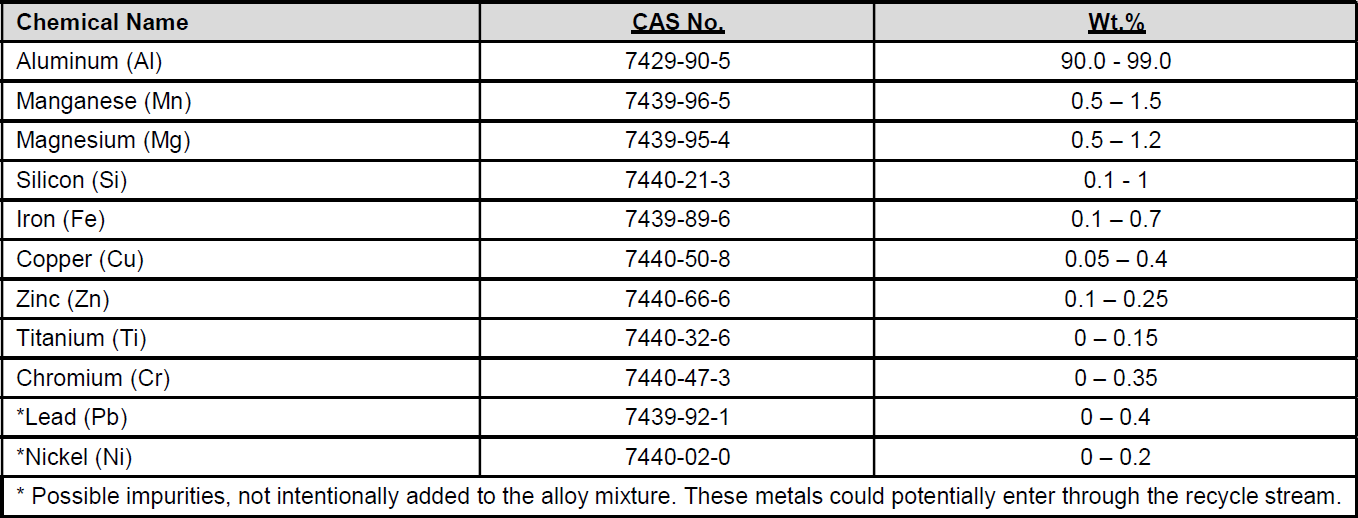
The values listed above represent reasonable approximations suitable for general engineering use. Due to commercial variations in compositions and to manufacturing limitations, they should not be used for specification purposes. See applicable ASTM International specification references.
4.1 Description of first aid measures:
Inhalation: If symptoms are experienced, remove source of contamination or move person to fresh air. Get medical advice/attention if you feel unwell or are concerned.
Eye Contact: Do not allow victim to rub eye(s). Let the eye(s) water naturally for a few minutes. Have victim look right and left, and then up and down. If particle does not dislodge, flush with lukewarm, gently flowing water for 15 minutes or until particle is removed, while holding the eyelid(s) open. If irritation persists, get medical attention. DO NOT attempt to manually remove anything stuck to the eye(s).
Skin Contact: If on skin, wash with plenty of water. If skin irritation occurs, get medical advice.
Ingestion: Call a Poison Centre or doctor if you feel unwell or are concerned.
4.2 Most important symptoms and effects, acute and delayed:
No adverse health effects expected when handled properly. Refer to Section 7 of this SDS for safe handling information.
Inhalation: Overexposure to metal dust or fume may cause coughing, shortness of breath, respiratory tract irritation, nasal septum perforation, congestion of the mucous membranes, lung damage and/or metal fume fever. The symptoms of metal fume fever typically appear several hours after exposure and are associated with any combination of the following symptoms: dry throat, cough, chills, fever, headache, chest tightening, shortness of breath, metallic taste, vomiting and fatigue. Metal alloy may contain up to 0.4% lead; repeated exposures to low levels of lead from dust and/or fume may result in an accumulation of lead in the body. Exposure to Lead may cause cancer.
Eye Contact: Overexposure to this material in the form of metal fragments may cause mechanical irritation as a “foreign object”. Fumes may be irritating to the eyes. Repeated occupational exposures to dust and fumes may cause conjunctivitis.
Skin Contact: Overexposure to this material in the form of metal fragments or dust may cause mechanical irritation or dermatitis. Contact with the heated product will cause thermal burns.
Ingestion: Swallowing metallic dust may cause a metallic taste, gastro-intestinal discomfort with nausea, vomiting and diarrhea.
4.3 Indication of any immediate medical attention and special treatment needed:
Not available
4.4 Medical Conditions Aggravated by Exposure:
Pre-existing pulmonary and skin conditions may be aggravated by exposure to fumes and dusts of this material.
5.1 Extinguishing media:
Do not apply water to hot or molten metal.
For aluminum fines or molten aluminum, smother fire with dry sand, dry clay, dry ground limestone, dry sodium chloride based extinguishers or use approved Class D dry powder extinguishers.
For aluminum fines or molten aluminum, DO NOT use carbon dioxide, sodium bicarbonate, halogenated extinguishing agents, foam or water. Contact of burning aluminum with water forms flammable hydrogen gas, an extremely dangerous explosion hazard, particularly if the fire is in a confined area.
5.2 Special hazards arising from the substance or mixture:
Bulk aluminum metal is not flammable.
Workplaces where metal processing involves machining operations such as grinding, polishing, blasting or cutting may release metal particles such as filings or dust.
Finely divided metal dust (500 μm or smaller) from metal processing can form explosive dust-air mixture, which can be ignited by a spark or flame. Explosions of aluminum dusts have occurred in industry. For safe handling information refer to NFPA 484, Standard for Combustible Metals.
Potential sources of ignition include open flames, welding equipment and cutting torches, matches and cigarettes, faulty electrical equipment and static electrical discharges. These conditions must be avoided in areas where dust producing processes are carried out.
When heated, as in a fire, aluminum powder will react with water or steam to produce extremely flammable/explosive hydrogen gas which can detonate, particularly in a confined space.
5.3 Advice for firefighters:
As for any fire, evacuate the area and fight the fire from a safe distance. Wear a pressure-demand, self-contained breathing apparatus and full protective gear.
6.1 Personal precautions, protective equipment and emergency procedures:
Wear approved personal protective equipment as indicated in Section 8.
6.2 Environmental precautions:
Prevent material from contaminating soil and from entering sewers or waterways.
6.3 Methods and materials for containment and cleaning up:
Scoop or shovel spilled material into an appropriate waste container for recycling or disposal. For dust, use a vacuum with appropriate filters or a wet method to reduce airborne dust during clean-up; do not dry sweep dusts.
7.1 Precautions for safe handling:
Refer to the applicable regulatory standards for safety in welding, cutting and allied processes (e.g. OSHA standards related to welding, cutting and brazing, ANSI Z49.1 or CAN/CSA-W117.2-12). Workers involved in welding operations must be properly trained and certified.
Wear appropriate personal protective equipment suitable for the type of operation and conforming to workplace requirements.
Avoid operations that generate fumes or fine dust.
Dust accumulations must not be allowed to build up on floors, piping, ductwork, conduit, exposed building structural members or walls.
Refer to recommended handling practices for bending, joining, soldering, brazing and welding of aluminum tube.
If processing of this product generates dust or fine particulate, obtain and follow the safety procedures and equipment guides contained in Aluminum Association Bulletin F-1 and NFPA 484, Standard for Combustible Metals.
7.2 Conditions for safe storage, including any incompatibilities:
Product should be stored in a clean, dry area.
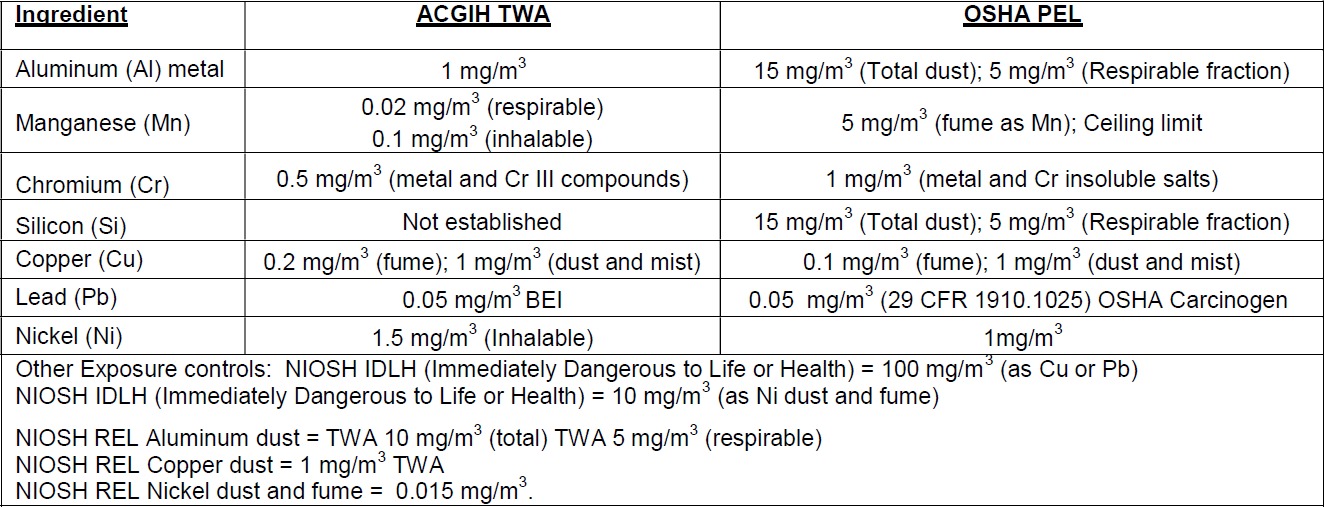
8.1 Control parameters:
Occupational Exposure Limits: Consult local authorities for acceptable exposure limits.
8.2 Exposure controls:
Engineering Controls: General ventilation is usually adequate. In workplaces where fumes or dusts are generated, provide local exhaust ventilation or general dilution to maintain exposure levels below the exposure limits. Monitor the workplace air to determine the effectiveness of ventilation. For welding, cutting and allied processes refer to the ventilation recommendations in the applicable safety standard (e.g. OSHA, ANSI or CSA).
If engineering controls and work practices are not effective in controlling exposure to this material, then wear suitable personal protective equipment including approved respiratory protection. Have equipment available for use in emergencies such as spills or fire.
Monitor noise levels to determine the hearing protection requirements.
Personal Protection: Workers must comply with the Personal Protective Equipment requirements of the workplace in which this product is handled. Wear equipment appropriate to the process (e.g. welding).
Eye/Face Protection: Wear safety glasses with side shields or goggles. For brazing or welding operations, wear eye/face protection that meets the occupational safety standard.
Skin Protection: Wear suitable gloves and long sleeve clothing to protect skin during cutting and high temperature handling. Wear safety footwear. Consult safety supplier for glove, clothing, and boot specifications.
Respiratory Protection: When metal fume or dust concentrations in air exceed the occupational exposure guidelines, always wear respiratory protection. If respiratory protection is required, institute a complete respiratory protection program including selection, fit testing, training, maintenance, and inspection.
Where metal dust is generated and is not controlled by engineering controls, wear an approved dust respirator.
A respiratory protection program that meets the regulatory requirement, such as OSHA’s 29 CFR 1910.134, ANSI Z88.2 or Canadian Standards Association (CSA) Standard Z94.4-2018, must be followed whenever workplace conditions warrant a respirator’s use.
Other Protection: Wear hearing protection appropriate to the noise levels during all machine operations.
9.1 Information on basic physical and chemical properties:
Appearance: Solid. Metal tube or shaped piece, lustrous silver color
Odor: Odorless
Odor threshold: Not available
pH: Not available
Melting point: 480 – 660°C (896- 1220°F)
Initial boiling point and boiling range: Not available
Flash point: Not applicable
Flammability (solid, gas): Not flammable
Auto-ignition temperature: Not available
Upper/lower flammability or explosive limits: Not available
Sensitivity to mechanical impact: Not applicable
Sensitivity to static discharge: Not available
Vapor pressure: Not applicable
Vapor density: Not applicable
Relative density: 2.5 – 2.9 at 25°C (77°F)
Solubility (ies): Insoluble
Partition coefficient (n-octanol/water): Not available
Decomposition temperature: Not available
Viscosity: Not applicable
10.1 Reactivity:
Product, as sold, is a bulk metal article which is stable and non-reactive under normal conditions of use, storage and transport. Molten aluminum may explode on contact with water. Bulk aluminum powder in contact with water may heat spontaneously.
10.2 Chemical Stability:
Normally stable. Aluminum metal powder, when damp, may heat spontaneously and form flammable hydrogen gas.
10.3 Possibility of Hazardous Reactions:
Finely divided metal dust from grinding or cutting may explode in contact with strong oxidizing agents, halogens, carbon disulfide or methyl chloride.
10.4 Conditions to Avoid:
Avoid generation of dust, moisture, heat, sparks, flames and other sources of ignition.
10.5 Incompatible Materials:
Uncoated aluminum powder is very reactive and can react violently or explosively with many inorganic and organic compounds. Coated aluminum powder or aluminum powder which has formed a layer of aluminum oxide is less reactive.
Aluminum powder or dust can react violently or explosively with oxidizing agents (e.g. dinitrogen tetroxide, bromates, chlorates, sodium peroxide). Explosion of the reacted mixture may be triggered by heat, striking, banging or light friction.
Powdered aluminum reacts violently on heating with antimony, arsenic, phosphorous, sulfur or selenium.
Aluminum powder or metal may undergo violent or explosive reactions (“thermite” reaction) on heating with metal oxides, oxosalts or sulfides (e.g. copper or lead oxides, nitrates, sulfates).
An explosion may occur when aluminum powder or dust is mixed with ammonium nitrate, ammonium persulfate and water, halogenated hydrocarbons, silver chloride, sodium carbonate, or fluorochloro-lubricants.
Aluminum dust when heated is ignitable and explosive in carbon dioxide atmospheres.
Violent explosions my occur with aluminum metal and halogenated hydrocarbons, due to the formation of aluminum chloride, which catalyses further decomposition.
Mixtures of aluminum powder with halogens, interhalogens, nitro compounds and water can ignite.
Aluminum ignites in non-metal halides (e.g. phosphorous pentoxide) and in the gases carbon disulfide, nitrous oxide, nitrogen tetroxide, phosgene or sulfur dioxide.
Aluminum and diborane react spontaneously to form complex hydrides which ignite in air.
Aluminum powder reacts with water, strong acids, strong bases or alcohols to release flammable hydrogen gas.
10.6 Hazardous Decomposition Products:
Moist aluminum powder may ignite in air, with the formation of flammable hydrogen gas.
11.1 Information on toxicological effects:
Likely routes of exposure
No known health hazards from Aluminum tube in solid form. Inhalation exposures to dust and fume from processing.
Acute Toxicity
Inhalation: Data not available. Inhalation of metal fume from high heat processes may cause a condition known as metal fume fever. Symptoms of metal fume fever include dryness and irritation of the throat, metallic taste, tightness of the chest and cough. Symptoms may occur be delayed several hours following exposure.
Ingestion: Data not available.
Skin: Data not available.
Acute Toxicity Data
Data not available for the solid article.
Skin corrosion / irritation
Data not available. Exposure to particulate may cause irritation and discomfort.
Serious eye damage / irritation
Data not available. Contact with particulates may cause mechanical irritation.
STOT (Specific Target Organ Toxicity) – Single Exposure
From exposures to metal fume and dust: Upper respiratory system, Eyes, Skin.
STOT (Specific Target Organ Toxicity) – Repeated Exposure
Exposures to Nickel: Causes damage to the respiratory tract through prolonged or repeated exposure by inhalation (particles under 0.1 mm diameter). Inhalation of Nickel containing dusts may cause inflammatory lesions (e.g., chronic inflammation, interstitial infiltrates) in the lungs and damage to the nasal epithelium.
Exposures to Manganese: Long-term exposures, by inhalation or ingestion, to high concentrations of dusts containing manganese may cause nervous system effects including muscle weakness, tremors, and behavioral changes.
Exposures to Lead: Long-term, repeated exposures to low levels of Lead from dust and/or fume may result in an accumulation of Lead in the body. Lead may affect the GI tract, Central Nervous System (CNS), kidneys, blood, gingival tissue and eyes.
Aspiration hazard
Not known to be an aspiration hazard.
Sensitization – respiratory and/or skin
Not known to cause respiratory or dermal sensitization.
Carcinogenicity
Copper metal is not considered a human carcinogen by IARC (International Agency for Research on Cancer), ACGIH (American Conference of Governmental Industrial Hygienists), OSHA or NTP (National Toxicology Program). ACGIH has designated metallic Copper as A4 – Not Classifiable as a Human Carcinogen.
Nickel metal carcinogenicity: IARC Group 2B carcinogen (possible human carcinogen by inhalation).
Lead carcinogenicity: IARC Group 2A. ACGIH has designated lead as an animal carcinogen A3. NTP has listed lead as reasonably anticipated to be a human carcinogen. [Lead is present at less than 0.1%].
Reproductive toxicity
Development of offspring: Long-term, repeated exposures to low levels of Lead from dust and/or fume may result in an accumulation of Lead in the body. Lead: saturnism; injury during the postnatal period in humans. May cause harm to the unborn child. [Lead is present at less than 0.1%].
Sexual function and fertility: Not known to cause effects on sexual function or fertility. Lead: embryotoxicity in animals, reproductive toxicity in humans. Possible risk of impaired fertility. [Lead is present at less than 0.1%].
Effects on or via lactation: No information was located.
Germ cell mutagenicity
Data not available.
Interactive effects
No information was located.
12.1 Toxicity:
Aluminum metal is not classified as an environmentally hazardous substance.
Do not release metal fragments, dust or solid metal to the environment.
12.2 Persistence and degradability:
Solid metal, not readily biodegradable.
12.3 Bioaccumulative potential:
Data not available
12.4 Mobility in soil:
Data not available
13.1 Waste treatment methods:
Aluminum tube is recyclable.
It is the responsibility of the user to dispose of, or send for metal reclamation, any unused material, residues and containers in accordance with local, regional, national and international regulations. Prevent releases of this material into the environment.
Do NOT discard into any sewers, on the ground or into any body of water. Store material for disposal or recycling as indicated in Section 7 Handling and Storage.
14.1 UN Number:
Not regulated
14.2 Shipping name:
Not regulated
14.3 Transport hazard class(es):
Not regulated
14.4 Packing group:
Not regulated
14.5 Environmental hazards:
Not available
14.6 Special precautions for user:
Not available
14.7 Transport in bulk according to Annex II of MARPOL 73/78 and the IBC Code:
Not applicable
15.1 Safety, health and environmental regulations/legislation specific for the substance or mixture:
USA
TSCA Status: All ingredients are on the TSCA Inventory or are exempt from TSCA Inventory requirements.
OSHA HazCom 2012 Hazards: As sold, the solid manufactured article is not considered a hazardous product. From processing: Combustible dust. May form combustible dust concentrations in air.
SARA Title III: May contain chemicals subject to the reporting requirements of Sara Section 313, including: Aluminum, Copper, Manganese, Zinc, Chromium, Lead, Nickel.
CERCLA RQ: Applicable to Aluminum, Copper, Manganese, Zinc, Chromium, Lead, Nickel. The RQ for these hazardous substances is limited to those pieces of the metal having a diameter smaller than 100 μm.
Canada
This product has been classified in accordance with the hazard criteria of the Controlled Products Regulations and the SDS contains all the information required by the Controlled Products Regulations.
WHMIS Classification: As sold, this product is considered a manufactured article and is not classified as a hazardous product. In some workplaces, operations with this product may lead to generation of metallic dust or fume. Exposure to metallic dusts and fumes may have occupational health hazards.
NSNR Status: All ingredients are listed on the DSL or are not required to be listed.
National Pollutant Release Inventory: Aluminum, Copper, Manganese, Zinc, Chromium, Lead, Nickel are NPRI reportable substances.
Revision date: January 512 2021
References and sources for data:
CCOHS, Chem info
RTECS, Registry of Toxic Effects of Chemical Substances
The Aluminum Association, F-1: Guidelines for Handling Aluminum Fines Generated During Various Aluminum Fabricating Operations.
Methods for classification of mixtures:
USA: Haz Com Standard 29 CFR 1910.1200 (2012)
Canada: Controlled Products Regulations WHMIS(1988); Hazardous Products Regulations WHMIS (2020)
Legend to abbreviations:
ACGIH – American Conference of Governmental Industrial Hygienist
ANSI – American National Standards Institute
CSA – Canadian Standards Association
GHS- Globally Harmonized System for Classification and Labeling.
NIOSH-National Institute for Occupational Safety and Health
OEL– Occupational exposure limit
OSHA – Occupational Safety and Health Administration
TWA – Time weighted average
TLV – Threshold Limit Value
WHMIS – Workplace Hazardous Materials Information System.
Additional information:
This Safety Data Sheet has been prepared for the guidance of plant engineering, operations, and management and for persons working with or handling this product. To the best of The Supplier’s knowledge and belief, the information within this document is accurate and reliable as of the date of preparation of this document. However, no warranty or guarantee, express or implied, is made as to the accuracy or reliability.
The Supplier shall not be liable for any loss or damage arising out of the use thereof, including abnormal use, or failure to adhere to recommended practices with respect to any hazards inherent in the nature of the product. This safety data sheet provides guidelines for the safe handling and processing of this product; it does not and cannot advise on all possible situations. Therefore, your specific use of this product should be evaluated to determine if additional precautions are required. Individuals exposed to this product should read and understand this information and be provided pertinent training prior to working with this product.
While Small Tube Products believes that the data set forth herein is accurate, as of the date hereof, Small Tube Products makes no warranty with respect thereto and expressly disclaims all liability for reliance thereon. Such data is offered solely for your consideration, investigation, and verification.
Prepared by:
Small Tube Products
200 Oliphant Drive
Duncansville, PA 16635
Tel: 814-693-6000
Fax: 814-696-0702
Contact Us for a Custom Product Review
Ready to discuss your control system tubing needs? Our team is here to help! Reach out today to request a product review and learn how WSTP can streamline your manufacturing process.
Find Your Sales RepAt Wieland Small Tube Products, we are more than a supplier—we are your trusted partner in precision, quality, and innovation for control system applications.